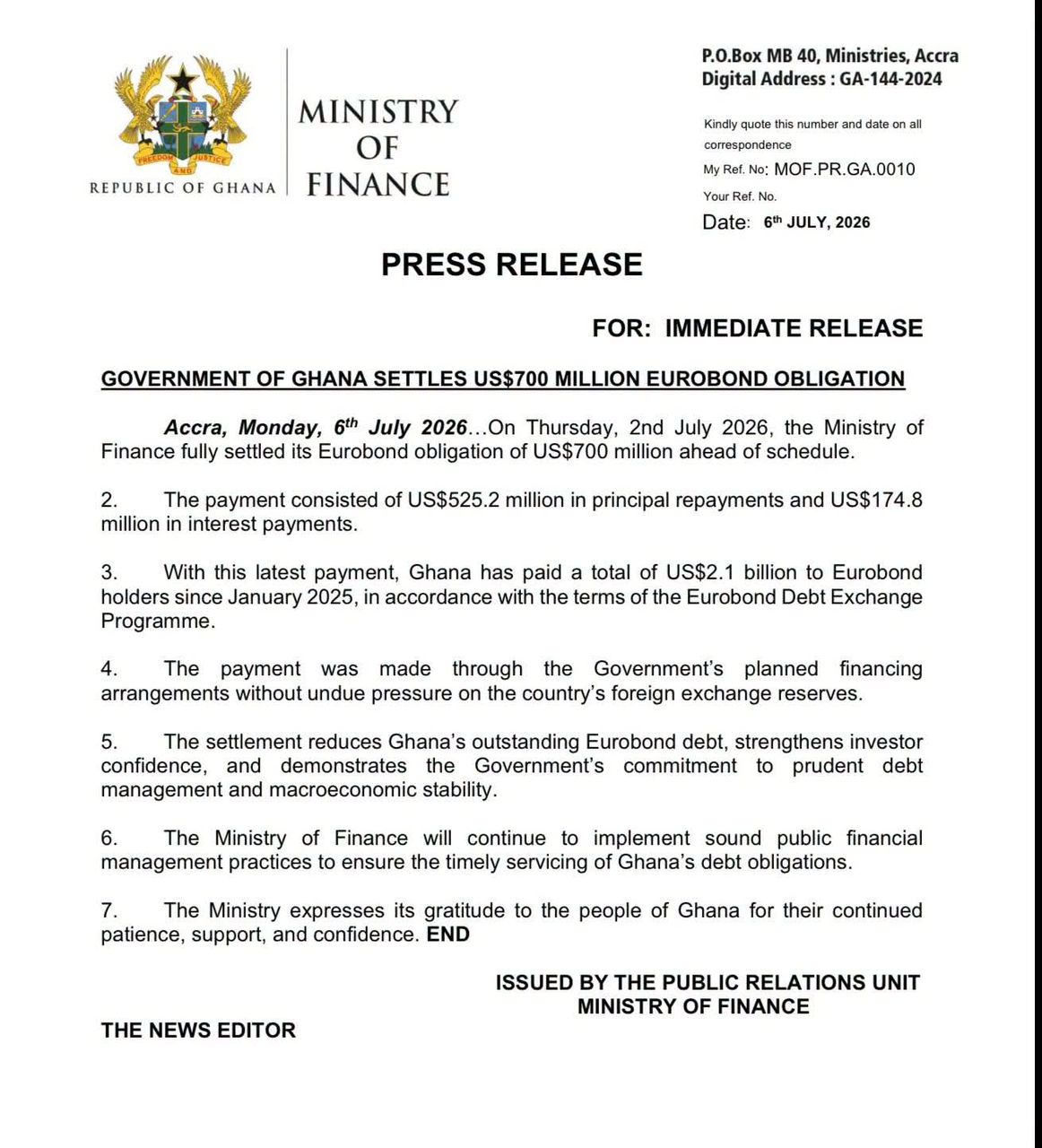
The Government of Ghana has announced the successful settlement of a US$700 million Eurobond obligation, completing the payment ahead of schedule on 2 July 2026, according to a press release issued by the Ministry of Finance.
The Government of Ghana has announced the successful settlement of a US$700 million Eurobond obligation, completing the payment ahead of schedule on 2 July 2026, according to a press release issued by the Ministry of Finance.
The payment comprised US$525.2 million in principal repayments and US$174.8 million in interest payments.
According to the Ministry, this latest payment brings the total amount paid to Eurobond holders to US$2.1 billion since January 2025, in line with the country’s Eurobond Debt Exchange Programme.
The Ministry further indicated that the repayment was financed through the Government’s planned financing arrangements without placing undue pressure on Ghana’s foreign exchange reserves.
It stated that the settlement would reduce Ghana’s outstanding Eurobond debt, strengthen investor confidence and reaffirm the Government’s commitment to prudent debt management and macroeconomic stability.
The Ministry also reiterated its commitment to sound public financial management practices to ensure the timely servicing of the country’s debt obligations.
𝗘𝗮𝗿𝗹𝘆 𝗘𝘂𝗿𝗼𝗯𝗼𝗻𝗱 𝗥𝗲𝗽𝗮𝘆𝗺𝗲𝗻𝘁 𝗦𝗶𝗴𝗻𝗮𝗹𝘀 𝗙𝗶𝘀𝗰𝗮𝗹 𝗗𝗶𝘀𝗰𝗶𝗽𝗹𝗶𝗻𝗲, 𝗕𝘂𝘁 𝗕𝗿𝗼𝗮𝗱𝗲𝗿 𝗗𝗲𝗯𝘁 𝗖𝗵𝗮𝗹𝗹𝗲𝗻𝗴𝗲𝘀 𝗥𝗲𝗺𝗮𝗶𝗻
The Government’s early settlement of the US$700 million Eurobond obligation represents another milestone in Ghana’s ongoing debt restructuring and economic recovery programme.
Following the domestic debt exchange and subsequent restructuring of Ghana’s external debt, restoring investor confidence has become one of the Government’s key priorities. Meeting debt obligations on time or ahead of schedule sends a positive signal to international investors that Ghana is committed to rebuilding credibility in the international capital market.
The Ministry’s statement that the repayment was made without undue pressure on foreign exchange reserves is particularly significant. It suggests that the Government relied on planned financing arrangements rather than emergency measures that could have weakened the cedi or reduced the country’s external buffers.
However, while the repayment is encouraging, it should be viewed within the broader context of Ghana’s public debt management strategy.
Key Issues to Watch
1. Debt Sustainability
Although Ghana has now paid US$2.1 billion to Eurobond holders since January 2025, the country still carries substantial public debt. Sustaining these repayments will require continued fiscal discipline, stronger domestic revenue mobilisation and prudent borrowing.
2. Fiscal Consolidation
The ability to continue servicing debt obligations depends heavily on improving tax collection, reducing expenditure inefficiencies and limiting unplanned borrowing. Any weakening of fiscal discipline could undermine the gains made under the debt restructuring programme.
3. Investor Confidence
Consistently honouring debt obligations strengthens Ghana’s reputation with international investors and credit rating agencies. This may eventually lower borrowing costs and improve access to international capital markets once the country returns to issuing Eurobonds.
4. Public Accountability
While debt repayments are important for maintaining macroeconomic stability, citizens also expect improvements in public service delivery. Continued transparency regarding how debt repayments are financed, alongside accountability for public expenditure, remains essential.
The early settlement of the US$700 million Eurobond obligation is a positive development that demonstrates progress in Ghana’s debt management efforts and adherence to commitments under the country’s restructuring programme. Nonetheless, sustaining these gains will depend on continued reforms to strengthen domestic revenue mobilisation, improve public financial management and maintain fiscal discipline.
For accountability advocates, the announcement reinforces the importance of transparent debt management and prudent use of public resources to ensure that debt servicing does not compromise investment in critical sectors such as health, education and infrastructure.