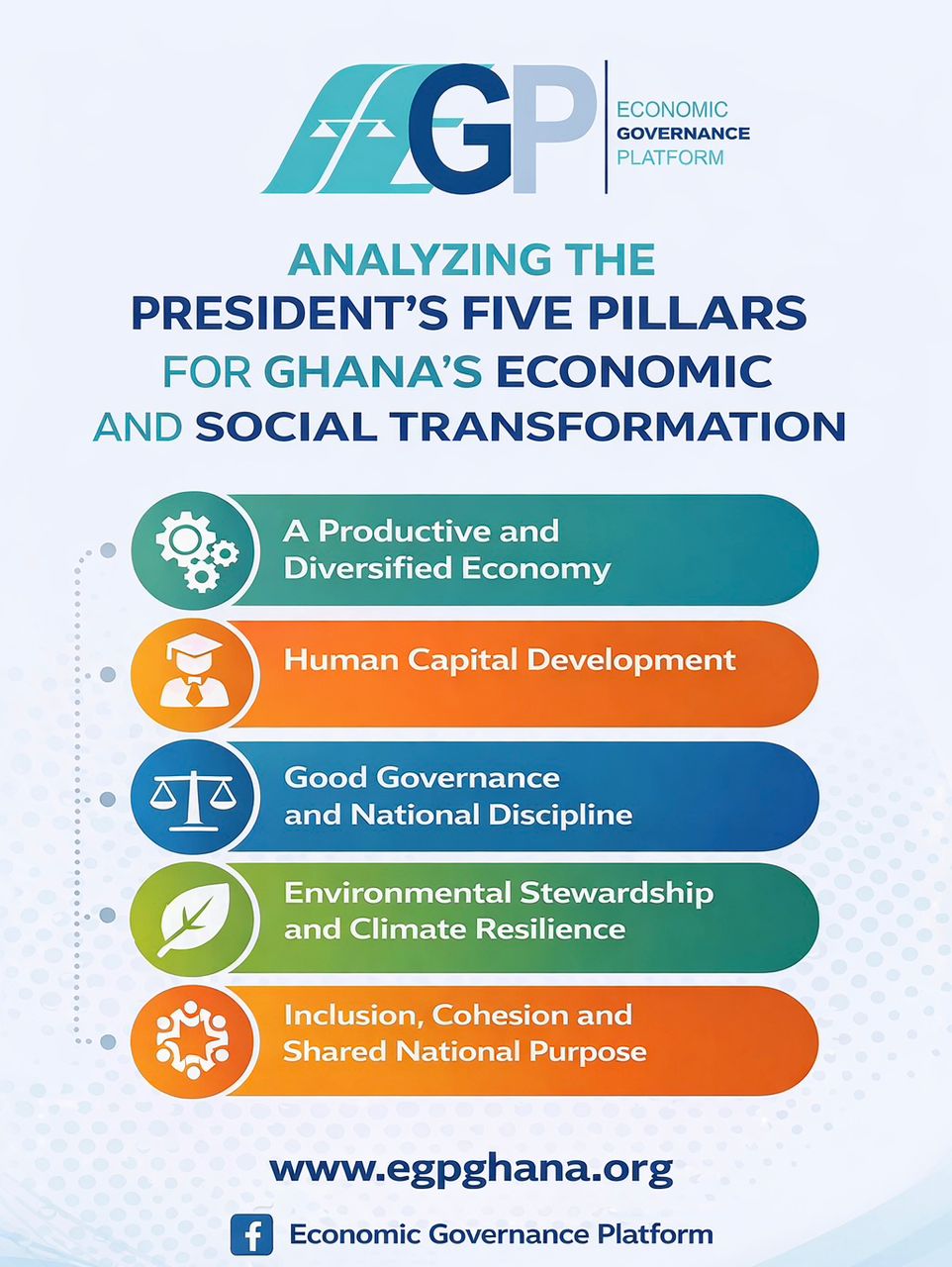
An empirical assessment of the feasibility and impact of the new strategic framework for Ghana's transformation.
This assessment examines the President’s Five Pillars as a strategic framework for Ghana’s economic and social transformation as reported by the Daily Graphic, with the aim of evaluating their feasibility, coherence, and potential impact. It seeks to move beyond broad policy statements by grounding the pillars in empirical evidence, current economic realities, and institutional capacity.
The assessment draws on credible national and international data to analyze how each pillar aligns with Ghana’s development challenges, including fiscal constraints, unemployment, human capital gaps, governance weaknesses, environmental pressures, and social inclusion. It evaluates both the opportunities presented by the pillars and the structural bottlenecks that could limit effective implementation.
1. A Productive and Diversified Economy
Ghana’s economic structure remains highly concentrated, making diversification an urgent necessity. According to the Ghana Statistical Service (GSS), agriculture, industry, and services contributed 21.3%, 32.4%, and 46.3% to GDP respectively in 2024, yet exports remain dominated by gold, cocoa, and oil, which together account for over 80% of export earnings. Manufacturing contributes less than 11% of GDP, well below the levels observed in peer emerging economies.
Productivity growth is also weak; the World Bank estimates Ghana’s labour productivity growth at below 1.5% annually over the past decade. This constrains job creation despite positive GDP growth. Achieving this pillar therefore requires scaling industrial value addition, lowering energy and credit costs, and expanding SME access to finance particularly long-term capital if diversification is to translate into resilience and employment.
2. Human Capital Development
Human capital outcomes in Ghana reveal a strong access–quality gap. While Free SHS has raised secondary school enrolment by over 30% since 2017, learning outcomes remain weak. The World Bank’s Human Capital Index (2023) places Ghana at 0.44, meaning a child born today will be only 44% as productive as they could be with full education and health.
Unemployment among youth (15–35 years) stands at over 19%, with underemployment significantly higher, reflecting persistent skills mismatch. In health, Ghana spends about 3.2% of GDP, below the Abuja target of 15% of government expenditure, contributing to NHIS arrears and health worker emigration. Without stronger investment in TVET, skills alignment, and health system financing, the human capital pillar risks yielding limited economic returns.
3. Good Governance and National Discipline
Governance weaknesses have been a central driver of Ghana’s fiscal distress. Public debt rose from 55% of GDP in 2019 to over 90% in 2023, prompting IMF intervention. The IMF Governance Diagnostic Assessment (2024) highlights vulnerabilities in procurement, SOE oversight, and asset declaration enforcement.
Corruption-related inefficiencies are estimated by Transparency International and UNDP to cost Ghana 2–3% of GDP annually, equivalent to several billion cedis in lost public resources. While institutions such as the Auditor-General and OSP exist, enforcement remains uneven. This pillar can only be realized if fiscal rules are respected beyond IMF conditionality, procurement transparency is strengthened, and accountability institutions are insulated from political influence.
Related Topics
#Policy#Economy#Development#Analysis