
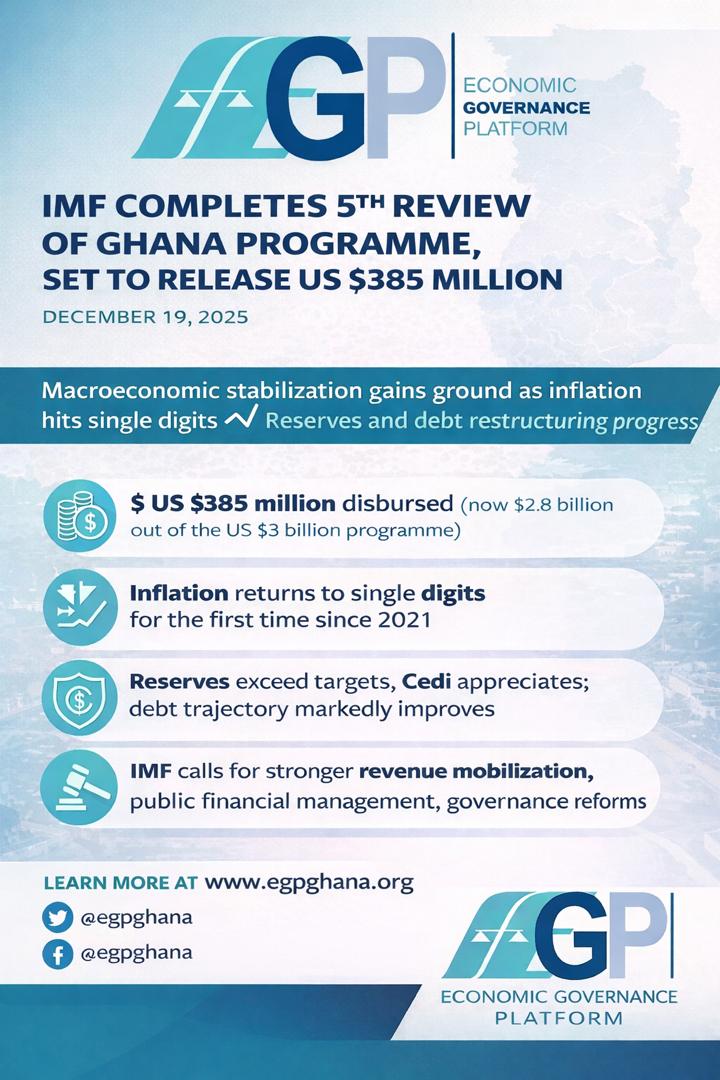
The Executive Board of the International Monetary Fund (IMF) has completed the fifth review of Ghana’s 39-month Extended Credit Facility (ECF) arrangement, approving the immediate disbursement of about US$385 million (SDR 267.5 million). This brings total IMF disbursements to Ghana to approximately US$2.8 billion under the US$3 billion programme approved in May 2023.
According to the IMF, Ghana’s performance under the programme has been broadly satisfactory, with all quantitative performance criteria and indicative targets for the review met. The Fund noted that macroeconomic stabilisation is gaining momentum, supported by stronger-than-expected economic growth, improved fiscal and external balances, and progress on debt restructuring. Inflation has returned to single-digit levels for the first time since 2021, while foreign exchange reserves have exceeded programme targets, aided by strong gold and cocoa exports and renewed investor confidence.
The IMF acknowledged continued progress on public debt restructuring, with Ghana having signed bilateral agreements with several official creditors and reached Agreements in Principle with multiple commercial creditors. Fiscal discipline remains central to the programme, with Ghana on track to achieve a primary surplus of 1.5% of GDP by end-2025. The 2026 Budget, now before Parliament, aligns with programme objectives and the new fiscal responsibility framework, balancing consolidation with development and social protection priorities.
The Fund welcomed the Bank of Ghana’s cautious monetary easing, following declining inflation and recent appreciation of the cedi, while emphasizing that further easing should remain gradual and data-dependent. It also highlighted steps taken to safeguard financial stability, including reforms in state-owned banks, improved crisis management frameworks, and measures to reduce non-performing loans.
Despite the positive outlook, the IMF stressed that sustained reform momentum is essential. Stronger domestic revenue mobilization, improved public financial management, better oversight of state-owned enterprises, and deeper governance and anti-corruption reforms remain critical to maintaining macroeconomic stability, restoring debt sustainability, and creating an environment conducive to private-sector-led growth and job creation.
OXFAM in Ghana Ghana Anti-Corruption Coalition BudgIT Open Society Foundations World Bank Theo Acheampong International Monetary Fund John Dramani Mahama